Drivers Side Mirror for a Blue 2009 Ford Focus Coupe Ses
The 2009 Ford Focus Coupe SES is a Front-wheel drive Coupe. It can accommodate up to 5 passengers. It has 2 Doors and is powered by a 2.0L L4 DOHC 16-valve engine which outputs 140 hp @ 6000 rpm and is paired with 4-speed automatic transmission gearbox. The 2009 Ford Focus Coupe SES has cargo capacity of 391 Liters and the vehicle weighs 1174 kg. In terms of ride assists, the 2009 Ford Focus Coupe SES has stability control and traction control in addition to anti-lock brake system (ABS). The vehicle has an optional engine as well It offers and. Safety features also include Driver-side front airbag and Passenger-side front airbag. The front suspension is Independent front suspension while the rear suspension is Independent rear suspension. The car also features a Yes It has 17'' painted alloy wheels as standard. Electronic features include Cruise Control. For convenience, the car has Power windows and Power door locks. There is also a remote keyless entry feature. Moreover, the car has. The steering wheel has audio control buttons. In terms of performance, the car has 153 N.m of torque and a top speed of 191 km/h. The 2009 Ford Focus Coupe SES accelerates from zero to 60 mph in 8.9 seconds and hits quarter mile at 16.4 seconds. Fuel consumption is 8.5 L/100km in the city and 6 L/100km in the highway. The car price starts at $ 19,799
0-100 km/h Ford Focus RS 2009
2009 Ford Focus 0-60
FSWERKS 2009 Turbo Ford Focus Coupe Acceleration
Infiniti FX35 vs Ford Focus ST - Drag Race 2009 II
2009 FORD FOCUS SE GREAT GAS MILEAGE EXTRA CLEAN Mobile Pensacola FL Florida
2009 Ford Focus top speed run
2009 Ford Focus Used Price Estimates
Estimates based on a driving average of 12,000 miles per year
| Used Condition | Trade In Price | Private Party Price | Dealer Retail Price |
|---|---|---|---|
| Outstanding | $ 2,487 | $ 3,302 | $ 3,792 |
| Clean | $ 2,283 | $ 3,039 | $ 3,491 |
| Average | $ 1,873 | $ 2,512 | $ 2,889 |
| Rough | $ 1,464 | $ 1,986 | $ 2,286 |
The 2009 Ford Focus is a good value, but those in the market for a refined compact sedan or performance-oriented coupe should look elsewhere.
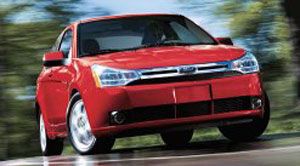
Even nearly a decade into its lifespan, the Ford Focus is still doing a pretty good job of holding its own. In a small-car segment dominated by imports, the Focus generally finishes in a respectable 3rd place sales-wise behind more popular Japanese rivals. Some credit goes to the significant refresh Ford performed last year, which blessed the Focus with a new coupe body style and an interior upgrade, among other changes. Mechanically, last year's Focus stood pat, but there was still enough inherent goodness to keep plenty of small-car buyers happy.

For the 2009 Focus, Ford has made a few more changes. It seems Ford listened to criticism about the car's odd styling elements, as the coupe has been given sleeker-looking front and rear fascias, and those dopey-looking fake fender vents have been put out to pasture. On the SES trim, Ford throws in a few exclusives, including dark-painted wheels, a new sport exhaust (which increases horsepower a bit) and a shorter final-drive ratio for the automatic transmission, to improve acceleration. The rest of the Focus is pretty much the same, though stability control is now an option again -- oddly, it debuted in the early 2000s, only to disappear in 2005.

The 2009 Ford Focus certainly has some things going for it. Its fuel economy is better than average, and the Sync interface, which allows voice control of MP3 players and cell phones, works impressively well. The Focus is also priced competitively. But those looking for engaging handling and a premium ownership experience will want to look elsewhere. The Mazda 3, for example, is a much more engaging car to drive (though markedly thirstier). The Honda Civic is slightly more expensive, but it's a much better all-around performer. Overall, Ford's aged Focus is still a viable choice for a small sedan or coupe, but you'll certainly want to check out other options before deciding.
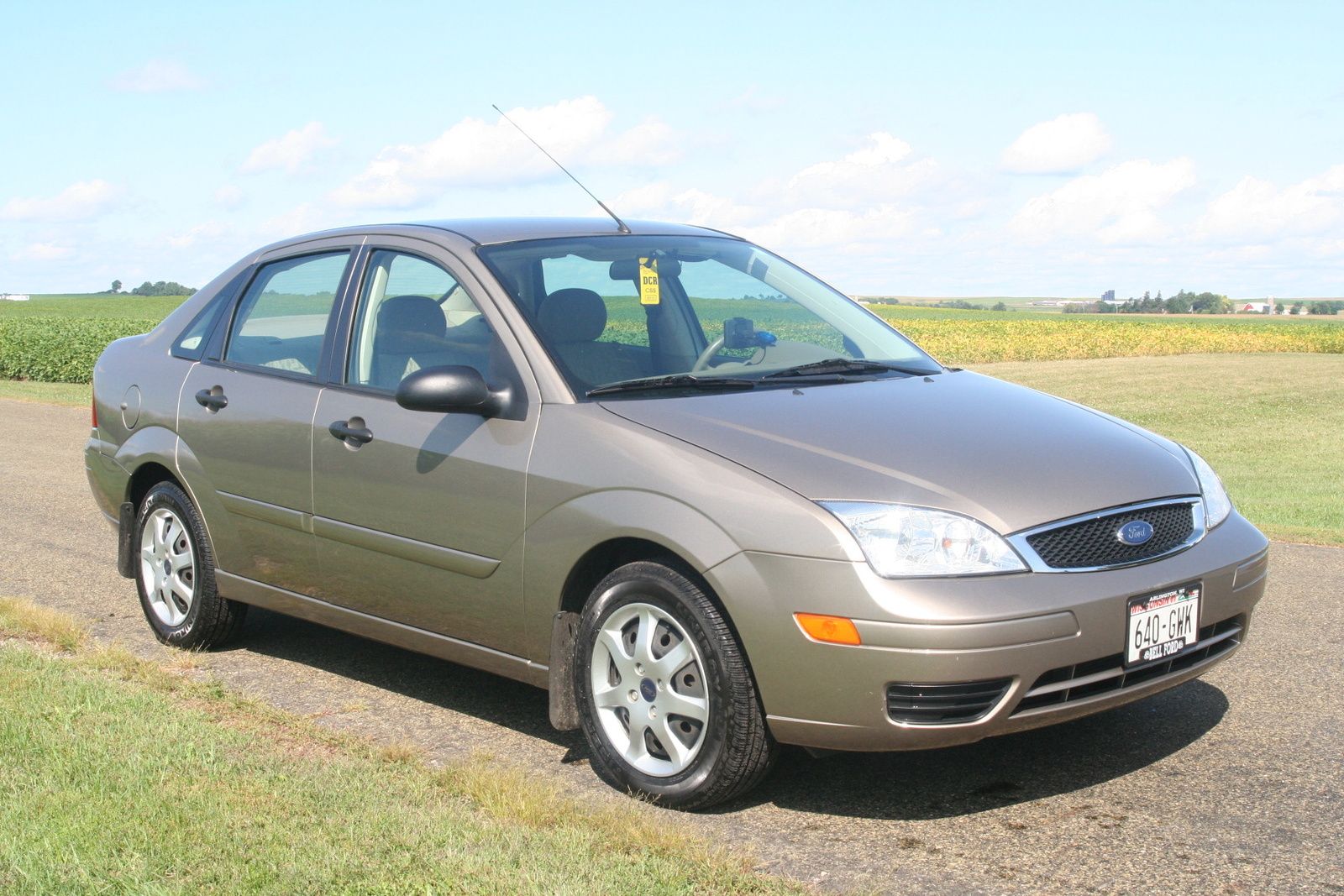
The 2009 Ford Focus is available as a sedan or coupe. The four-door body style is offered in four trim levels. The base S model comes standard with 15-inch steel wheels, air-conditioning, a tilting steering wheel and a four-speaker audio system with a single-CD/MP3 player and an auxiliary audio jack. Cruise control and satellite radio are on the options list. The SE adds full power accessories and Sirius Satellite Radio, and options like Sync, an upgraded stereo with a six-CD changer, heated side mirrors, chrome exterior trim, faux-aluminum interior trim, an upgraded driver seat, customizable interior lighting and a leather-wrapped steering wheel.
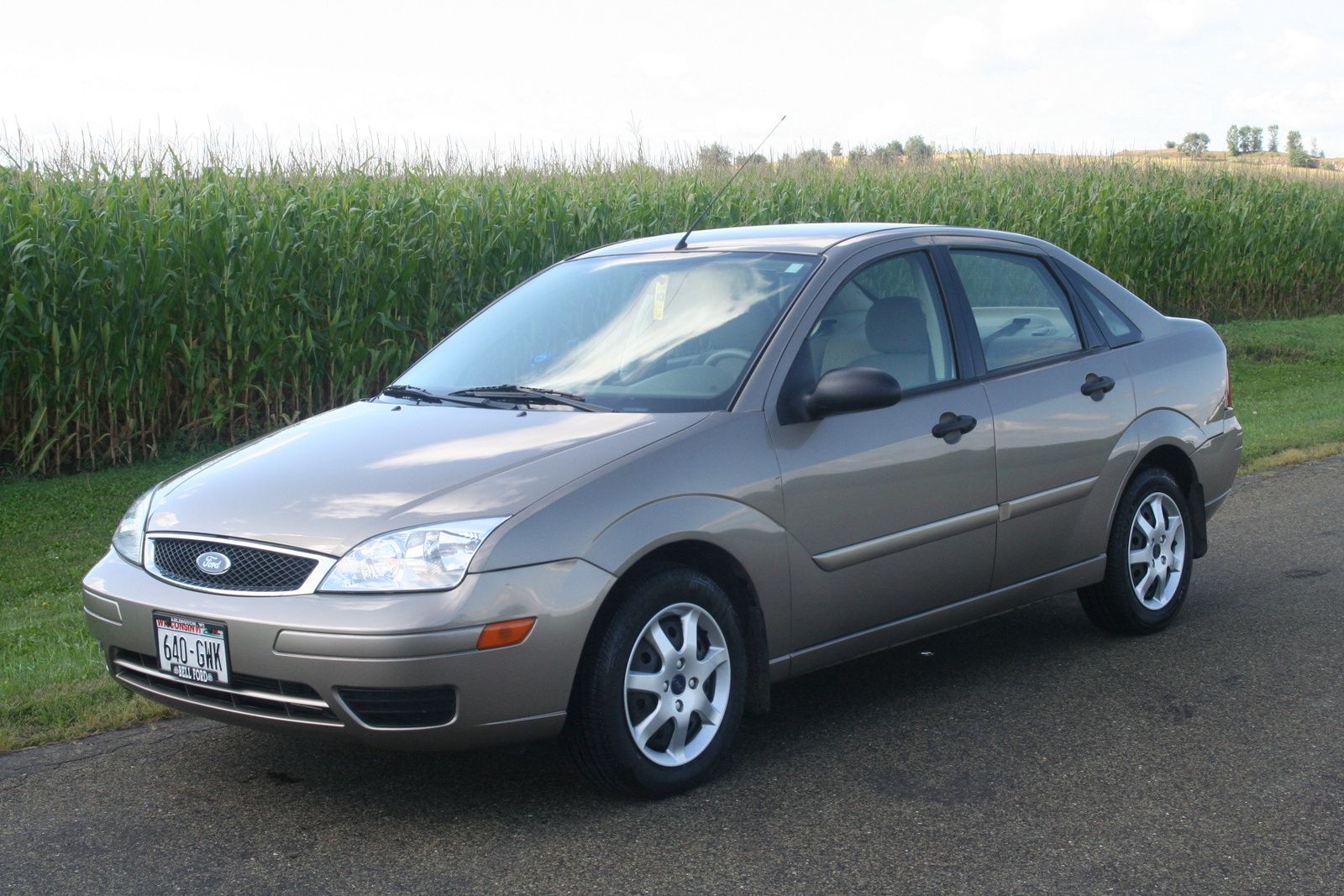
The SES trim will get you 16-inch alloy wheels and upgraded tires, foglamps and a rear spoiler, along with firmer suspension tuning for better handling. This well-equipped Focus also comes standard with much of the SE's optional equipment, including Sync and cruise control. Top-of-the-line SEL models have all SES features, plus chrome exterior trim and heated leather seats.

The Focus coupe is available in the SE and SES trim levels. They are largely similar to their sedan counterparts, though you'll find a sport exhaust and 17-inch wheels on the SES coupe.

Just one engine is available on the 2009 Ford Focus, a 2.0-liter inline four-cylinder good for 140 hp and 136 pound-feet of torque. A cleaner version of that engine that earns PZEV tailpipe-emissions certification is also available for California-emissions states. That engine makes 132 hp and 133 lb-ft of torque.

The standard transmission on all Focus trim levels is a five-speed manual. A four-speed automatic is available as an option. The automatic on SES coupes is geared slightly shorter for better acceleration. Fuel economy for the Ford Focus is rated at 24 mpg city/35 mpg highway and 28 mpg combined for the manual transmission. Opting for the automatic drops the highway estimate to 33 mpg.

Six airbags are standard on all Focus models, including front-seat side-impact airbags and side curtain airbags for both front- and rear-seat occupants. Antilock brakes and stability control are optional on all trim levels.
In government crash tests, the Ford Focus sedan earned four stars (out of a possible five) for its protection of front occupants in head-on collisions. In the side-impact test, the sedan received five stars for protecting front occupants and four stars for protection of those in the rear. Curiously, the Focus coupe earned a five-star rating for frontal impacts but just a three-star rating for front and rear side-impact protection. The Insurance Institute for Highway Safety gives the Focus a top rating of "Good" for frontal-offset crash protection.
The 2009 Ford Focus will get you where you want to go, but the driving experience is not particularly special. The quick steering is nice, but even the sport-tuned SES models lack the energetic handling feel that earlier Focus models were known for. The 2.0-liter engine is adequate in terms of power, though it makes raucous noises at higher engine speeds. Although five-speed automatics are becoming increasingly common in this segment, the Focus makes do just fine with four. Its gears are well-spaced, and the transmission rarely shifts up and down looking for the right gear, even on steep inclines. On the highway, road noise is about average for this segment and wind noise is nicely quelled.
The interior of the 2009 Ford Focus looks contemporary, thanks to last year's refresh. The front seats are flat but prove supportive on long drives. Compared to other small cars, however, the Focus' interior is nothing special in terms of design and materials, even with the optional aluminum-like trim highlights and colored interior lighting.
One key advantage for the Focus is Ford's Sync system. Essentially a hands-free voice-recognition interface, the Microsoft-developed Sync adds Bluetooth functionality to the Focus but requires fewer steps than other systems. You don't have to save voice tags or build lists of phone numbers, as Sync accesses your device's phone book wirelessly. It offers similar control for the iPod, Zune and other PlaysForSure portable MP3 players.
Handling has always been a Focus strong suit, and the comprehensive revamp of its fully independent suspension, coupled with a stiffer body structure, adds even more poise and control in that department. A rear anti-roll bar, Euro-style chassis tuning and larger 16-inch aluminum wheels (17 on the SES Coupe) wrapped in premium Pirelli tires make the SES the standout player as the roads get twistier. Large front disc and rear drum brakes improve stopping power, and all models offer an available anti-lock system with traction and stability control. Generous sound proofing, an acoustic windshield and thicker side glass help to lower cabin noise levels. While not the quickest car in its class, the 2009 Focus does deliver decent gas mileage, which should please those who favor efficiency over exhilaration.
SYNC In-Car Communications SystemDeveloped in conjunction with Microsoft, this state-of-the-art in-car hands-free cell phone and personal media player interface is remarkably functional and amazingly affordable at under $ 500. Optional Leather Upholstery Available on SES and standard on SEL models, it adds a touch of class to the interior of either the coupe or sedan.
Inside, the Focus gains functionality and boasts upgraded materials. The "organic" dash contouring that made the original Focus so youth-oriented gives way to a more traditional design, netting improved storage spaces, better-positioned controls and attractive ice-blue backlighting. Gauge faces are black on the S and white on SE, SEL and SES models, and a dash-top display graces the interior of all models. The large central accent panel, tan or black on S and SE, has an upscale brushed-nickel finish on the SES and SEL. Redesigned bucket seats provide more comfort and support up front, while the 60/40-split rear bench can handle two average-sized adults or three kids and adds utility to the 13.8 cubic-foot trunk.
The latest Focus borrows design cues from the more angular Edge and Fusion, gaining crisply-chiseled character lines and a chrome bar grille that help align it more closely with other Ford vehicles. Base S models come with 15-inch steel wheels; the SE gets alloy rims of the same size. The SES and SEL variants move up to 16-inchers, while the SES Coupe rides on 17-inchers. Chrome faux side vents add a bit of bling to the front quarter panels of SE, SES and SEL models and the top-line Focus also has body-color door handles and side mirrors and gets a subtle rear decklid spoiler.
Even the Focus S boasts a respectable basic roster of features, including high-efficiency air conditioning, a tilt steering column, dual 12-volt powerpoints and front, front-side and side-curtain airbags. It also includes an AM/FM/CD/MP3 sound system with auxiliary audio input. The SE, SES and SEL trims add power windows, locks and mirrors, keyless remote, driver information center and unique alloy wheels (15-inch on SE, 16-inch on SEL and 17-inch on SES Coupe). Moving up to the SES and SEL adds a leather-wrapped steering wheel with audio and cruise control switchgear, upgraded interior trim, an auto-dimming rear-view mirror, fog lamps and the slick SYNC in-car communications system.
All models can be fitted with anti-lock brakes, stability and traction control, an electrochromic rearview mirror – with or without Homelink and compass – remote starting for cars with automatic transmission and SIRIUS Satellite Radio. The SE offers the Driver's Group Package (cruise control, leather-wrapped steering wheel with auxiliary audio controls, electrochromic rear-view mirror) and the Moon and Tune Package (power moonroof and audiophile sound system with six-disc CD/MP3 changer). Other options include factory-installed ambient interior lighting, the SYNC audio system and leather seats (optional on SES, standard on SEL).
The Focus offers two variations on the existing 2.0-liter twin-cam Duratec four-cylinder engine. In Federal form, the engine makes 140 horsepower (143 in the Coupe) whether it's paired with the standard five-speed manual transmission or optional four-speed automatic. The "California-spec" engine, mandated in five states, makes only 132 horsepower but qualifies for Partial Zero Emissions Vehicle (PZEV) status. While both engines get similar fuel economy numbers in the city, the manual gearbox raises the official highway number from 33 to 35 mpg. Choosing to shift for yourself also results in a bit more spirited acceleration; but even with the automatic, any Focus can cope easily with in-town traffic, freeway on-ramps and highway travel. 2.0-liter in-line 4140 horsepower @ 6000 rpm 143 horsepower @ 6000 rpm (Coupe)136 lb.-ft. of torque @ 4250 rpmEPA city/highway fuel economy: 24/35 (manual), 24/33 (automatic)2.0-liter in-line 4132 horsepower @ 6000 rpm (PZEV)133 lb.-ft. of torque @ 4250 rpm EPA city/highway fuel economy: 24/35 (manual), 24/33 (automatic)
Ford's aggressive pricing schedule has the Focus S Sedan with a Manufacturer's Suggested Retail Price (MSRP) of less than $ 16,000, including destination fees. The SE Coupe starts just under $ 17,000. Even a fully-loaded SEL four-door will just touch the $ 22,000 mark. Ford's efforts at improving both the features and driving experience have helped bolster residual values across the entire Focus line. However, while it's now virtually equal to a Chevrolet Cobalt in that department, the Focus is still not on par with Japanese rivals, such as the Honda Civic, Mazda MAZDA3 or Toyota Corolla. In the long run, expect SE and SES models to do slightly better than the S when it comes time to sell or trade.
Henry Ford started the company in 1902 with $ 28,000 in cash from twelve investors, among which were John and Horace Dodge, who would later found the Dodge Brothers Motor Vehicle Company. He was 40 years when he first established the company's first factory on Bagley Street, Detroit.
He would later incorporate the firm on June 16, 1903. Ford Motor Company would go on and label their models chronologically in alfabetical order, starting with the Model A to the Model K and Model S, which was Ford's last right-hand steering vehicle. Then, in 1908 Ford introduced the Model T, which was designed by Childe Harold Wills and two Hungarian immigrants, Joseph A. Galamb and Eugene Farkas. This model proved to be of quintessential Ford vehicle, placing the company among the most influential automotive brands in history.
The Ford Model T was reliable, practical and affordable, which made it a big hit in the US, where it was advertised as the middle-class man's vehicle. The car's success compelled Ford to expand his business and layout the basics of mass production principles in 1913 with the introduction of the world's first vehicle assembly line. By 1912, production figures for the Model T alone reached nearly 200,000 units.
This organizational innovation brought in the vehicle construction field allowed Ford to reduce chassis assembly time by as much as 10 hours, dropping from 12 ½ h to 2h 40 min.
Besides ensuring the efficiency of the production process, Ford turned his company into an interactive entity by announcing a new profit-sharing policy. This would grant buyers a cut of profits if sales reached 300,000. As expected, sales effortlessly reached the 300k threshold and went even further to hit a record 501,000 in 1915.
As part of a new set of financial tactics, Ford provided working places for the disabled who otherwise had a hard time finding a job, reduced work shifts and doubled all employee's salaries. Changes like these sparked a tremendous sales increase while also setting the base of modern working conditions.
Still, the US and Canadian market would prove to be too small to fit Ford's plans. By the mid 20's, the Ford label had crossed the ocean and reached England, France, Germany, Denmark, Austria as well as distant Australia. The company's activity on European grounds further helped the brand's revenue growth.
War would not shake the Ford company as bad as other car makers. Post WWI improvements include the introduction of four-wheel brakes and a series of new vehicle releases to match new consumer demands. In 1922 Ford entered the luxury car segment with the acquisition of the Lincoln Motor Company, named after Abraham Lincoln whom Henry Ford admired.
Ford Motor Co. was one of the few big American corporations to survive the Great Depression, although the plummeting automotive sales led the company to scale down its operations and lay off many workers. In May 1929, Ford Motor Co. signed an agreement with the Soviet Union to provide technical assistance until 1938 to construct an integrated automobile-manufacturing plant at Nizhny Novgorod, in exchange for the Soviets purchasing $ 13 million worth of automobiles and parts. Under this agreement many American engineers and skilled auto workers went in 1932 to work on the Gorkovsky Avtomobilny Zavod (GAZ), or Gorki Automotive Plant. The few who remained in the Soviet Union after the completion of the plant fell victims to Stalin's Great Terror, ending either shot or exiled to Soviet gulags.
With the arrival of WWII Ford increased its influence on the global stage becoming an active player in the war effort, a thing underlined by US President Franklin Roosevelt referring to Detroit as the "Arsenal of Democracy." When the US War Department handed production of B-24 Liberator airplanes to Ford, the output rose to 20 airplanes per day instead of only one per day managed by the Consolidated Aircraft Corporation.
After WWII Ford continued its passenger vehicle operations and in 1955 introduced the iconic Thunderbird model. Then it introduced the Edsel brand in 1958, which proved to be a failure and was dissolved in 1960. Part Edsel's failure as an automotive brand resided in the onset of the 1957 recession in the States and the vehicle's high price tag.
Ford Motor Co. managed to get back up from its Edsel failure with the introduction of the Falcon model in 1960 and the Mustang in 1964. The company's next major step was represented by the formation of Ford Europe division in 1967.
Ford plunged into a state of brand-fatigue that would bring the company to the point of near bankruptcy. Following major sales losses in the 2000's, Ford was pinned against the wall by debts and the imminence of closing down.
Preferring to make it back on its own, Ford mortgaged all of its assets in 2006. As of then, the company has releases a variety of new models both under the Ford brand name and the rest of the sub-brands it owns such as fresher and edgier Mercuries and flashier Lincolns, Ford's luxury division. Business in Europe has also been good for Ford, especially after the introduction of the Focus model in 1997 and although it hasn't fully recovered, it's definitely on the way to regaining popularity.
johnsonlitill1936.blogspot.com
Source: https://www.mycarspecs.com/car/2009-ford-focus-coupe-ses

Post a Comment for "Drivers Side Mirror for a Blue 2009 Ford Focus Coupe Ses"